

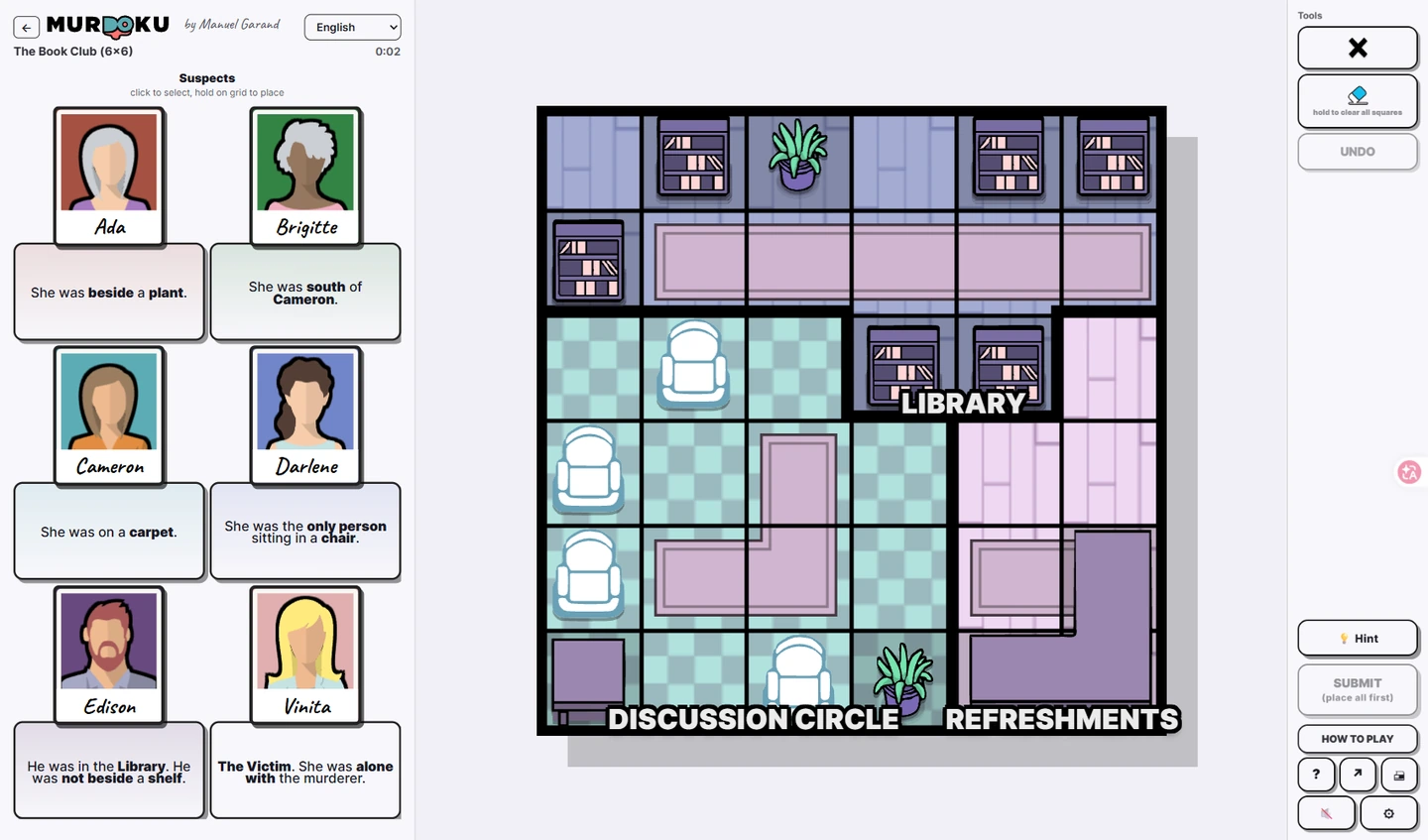
The objective of Murdoku
In Murdoku, every person on the clue cards belongs in a square on the crime-scene map. A finished board satisfies every card and places the victim alone with the murderer in one area. The case may add another question, such as identifying a person described as the outlaw. Read that question along with the basic goal before you put a marker on the board.
A Murdoku case has several kinds of information. The grid tells you where objects and areas are. The individual clue cards tell you what has to be true of a person. The case-wide clues, when present, describe rules such as room occupancy or a restriction about who can stand on a certain object. The information works together, so treat the cards and map as two views of the same puzzle.
Read the Murdoku board from the upper-left corner
Rows run horizontally and columns run vertically. On a Murdoku case page, the top-left square is R1C1, the square directly right of it is R1C2, and the square below it is R2C1. The order is row first, then column. Point to the square as you read the coordinate aloud if you are following a walkthrough. This prevents mistakes when a case has twelve or sixteen columns. On a large grid, check row and column labels separately before reading a long coordinate aloud.
Room or area lines on a Murdoku board show where clues about location and company apply. A path may run past a patch of sand, and a rug can span several grid squares. Read the named area as well as the object on the floor. The official English screenshots show room names you can match with the clue cards, the object key, and the positions on your map.
Apply the Murdoku row and column rule
Every row and every column holds at most one person in Murdoku. A confirmed placement at R2C4 uses all of row 2 and all of column 4. Exclude every other square on those two lines from every other person. The victim counts exactly like a suspect for this rule. A square that fits a clue may still be unavailable because another person already uses its row or column.
If a square Murdoku board has the same number of people as rows and columns, each line must be used. That gives you a reverse move. If only one square survives in a row, reserve that square for someone even when their identity is still unknown. A rectangular puzzle can leave a line empty. River Crossing has its own condition about an empty edge row, so read the case-wide rule before reserving a line there.
Read a Murdoku clue before marking the grid
An object clue in Murdoku might put someone on a carpet, in a car, or beside a plant. For a neighbor, begin by looking directly above, below, left, and right. Check whether the clue and room boundary require the neighbor to be in the same area. A cell across a wall may be just one square away and still fail the condition. The case’s map key helps distinguish objects that look similar.
Read direction clues literally. In Murdoku, “south of” sends you toward higher row numbers, and “west of” sends you toward lower column numbers. “Exactly one row south” requires the row numbers to differ by one. It does not specify a column unless the puzzle says so. If a clue mentions a diagonal, use equal row and column differences to check the relation instead.
Murdoku uses the words “only,” “alone,” and “exactly” for different jobs. “Only person sitting in a chair” removes all other chairs from everyone else’s candidate lists. “Alone in Reception” puts one person there and excludes everyone else from that area. “Exactly two people” sets a headcount that both rules out a third person and requires a second. Read the whole statement before marking any cells.
Mark candidates in the official Murdoku game
The official Murdoku site shows the board beside the clue cards and tools. Choose a person and follow the placement instructions on the official interface. Use the X tool to mark a square that cannot be used. The eraser and undo tool let you recover if you change an earlier decision. When the case offers a hint, you can use it to identify a clue worth checking.
Keep two kinds of marks distinct. On a Murdoku board, a candidate is a square that might still work. A placement is a square backed by a deduction you can repeat. Avoid crossing off a whole row or column for a candidate unless another clue proves that row or column belongs to that person regardless of which candidate is correct. In a paper solve, pencil letters make the distinction easy.
Try a first pass through The Book Club
Open The Book Club Murdoku case and look at the Library before reading any of the walkthrough. List its squares and remove the ones that violate the clue about shelves. Use the map key to confirm that you are looking at shelf tiles rather than part of a rug. If the list only has one eligible square, you have a placement worth writing down.
After you place someone, revisit each Murdoku clue that refers to an object. A chair or carpet might be present several times on the map, yet only one copy may remain after an entire row and column are blocked. On this case, the carpet and direction clues become much narrower after you leave the Library. You can open the case’s first hint for a nudge and stop before it gives a complete grid.
Check a Murdoku board before submitting it
Read each clue card again with your proposed grid in front of you. For a Murdoku clue about a named person, put one finger on each of their squares. Compare the rows, columns, and area boundary. For a furniture clue, check that the marker is on the right square or beside the object as requested. A correct-looking pair can still be separated by a wall.
Next, count the people in the victim’s area. The Murdoku murderer is the person alone with the victim in that area. Once the placements are set, use the official submit control and check any feedback there. If one square is wrong, return to the first point where you used an assumption. Reversing a single unsupported mark often restores several candidates at once.
Use a printed Murdoku board if you prefer pencil
From any case, choose a printable Murdoku worksheet and open the browser print dialog. The default sheet contains the clues and unsolved grid. Choose black and white if you need a grayscale copy. On a large case you can keep the clue sheet on one side of your desk and the map on the other. Optional answers print on later pages.
On paper, write a short list next to each Murdoku clue. For example, keep two candidate coordinates for a chair occupant rather than penciling that person’s full name into both squares. Mark a clear X when you eliminate a cell and use an outlined or circled letter for a placement. Leave a line next to the case-wide clue to record any room or column reservations.
Get help without spoiling a Murdoku case
Use the opening hint when you have read the clue cards and are unsure where to begin. The illustrated Murdoku walkthrough goes further. It includes coordinates, explains intermediate exclusions, and illustrates the steps with official game screenshots. The final answer gives the murderer and full set of positions. Unfold one section at a time if you want to work through the remaining steps yourself.
When the same problem repeats across Murdoku cases, learn the underlying move. The strategy guide shows how to reserve a line without finding a coordinate, rule out the crossed intersections of two candidates, and use room headcounts. Return to the case directory once you are comfortable with those moves. It lets you move up a difficulty or find a shorter board with the same kind of clue.